One Run, five stages.
A researcher has a genomic question, not a bioinformatics team. Traceome runs the pipeline in five stages: Plan, Align and call, Investigate, Findings and Report. The researcher approves at three points, and every step lands in one record, the Journey. Each stage in plain words first, then the technical detail for those who want it. The example is development Run H on HG001, a public reference sample; the demo Run (#457) replays the same sample with a larger request R21. Screenshots are the GUI replay of development Run Q, whose answers equal Run H's item for item R5.
Ask
A researcher asks a question, cites a paper or names the variants (or both), and uploads the raw DNA reads.
Technical detail
Run H registered a question, a request of 24 rsIDs and the HG001 paired FASTQ (1.91 GB + 1.95 GB). The 24 rsIDs are a test list, not a paper's: it covers edge cases and two IDs planted so they should not resolve. With a paper, the Run finds and reads it itself: from a bare citation, the paper reader pulled rs429358, rs7412 and rs1801133 out of Mullins 2020, each with its quote R12.
Plan
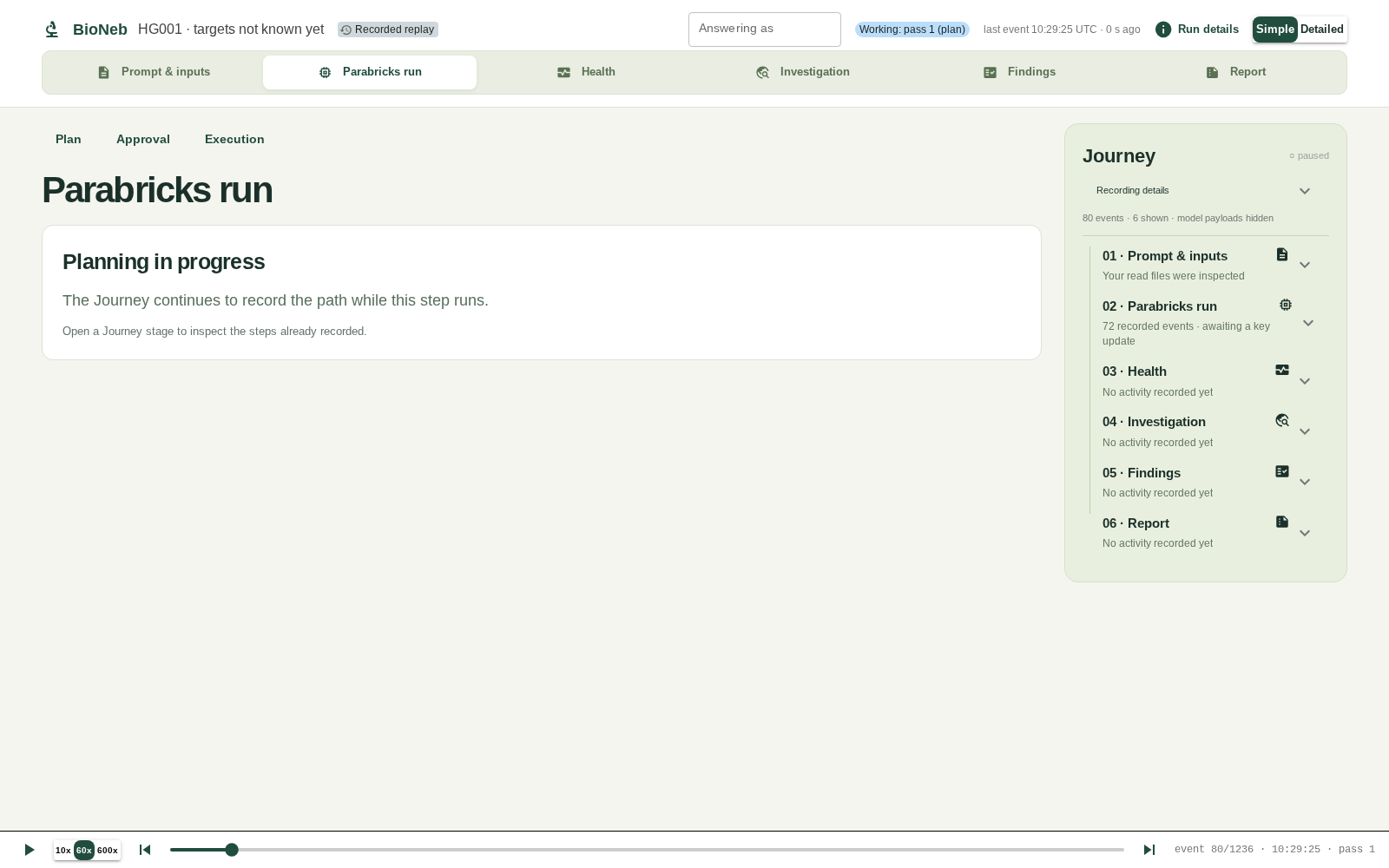
A planning agent identifies the reference genome and retrieves everything the alignment needs, ready for NVIDIA Parabricks.
Technical detail
The planning_agent (NVIDIA Nemotron 3.5 Super VL on Nebius Token Factory)
inspects the inputs, identifies GRCh38 through NCBI and compiles one complete Parabricks proposal R1.
Its output is a proposal, never a fact, until the researcher approves it.
You approve
Nothing consequential happens without the researcher. They approve three exact things: the compute plan, the Work items, and what the report may say. Each approval can be more than a yes.
Align and call
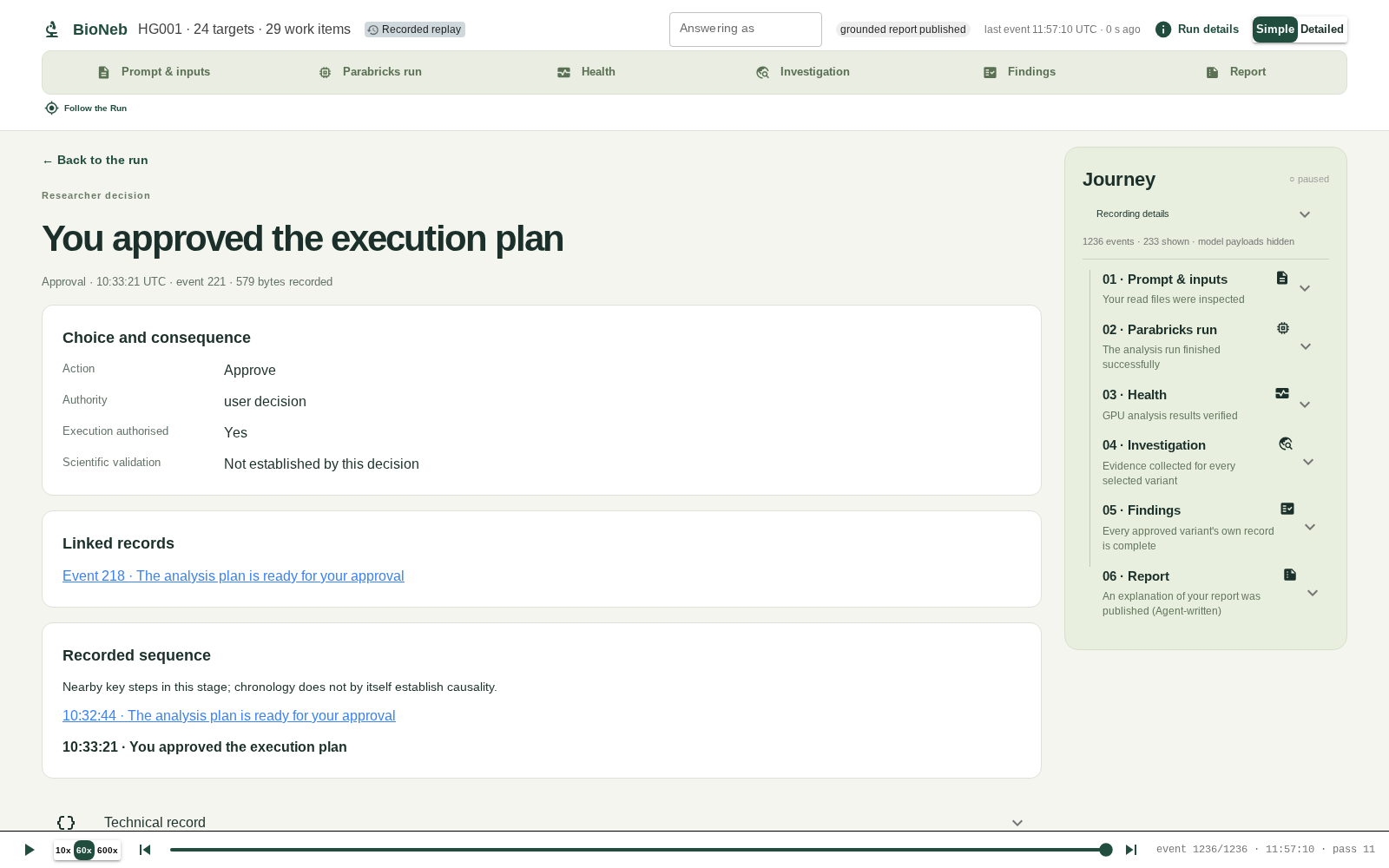
Once the researcher approves the plan, NVIDIA Parabricks aligns the reads and calls the variants on one GPU. The output files are verified before anything builds on them.
Technical detail
pbrun germline 4.7.0 runs as a Nebius Serverless
AI job on one H100 R6. Inputs go to a fresh Nebius Object Storage bucket;
the BAM and VCF (260,016 records) come back in parts and are verified byte for byte before Investigation starts.
A health step then measures the Run (reads mapped, depth, bases covered) and each Work item's coverage, and the
report shows it R19. Reads can also come from staged Object Storage
files, copied server-side R20.
Investigate
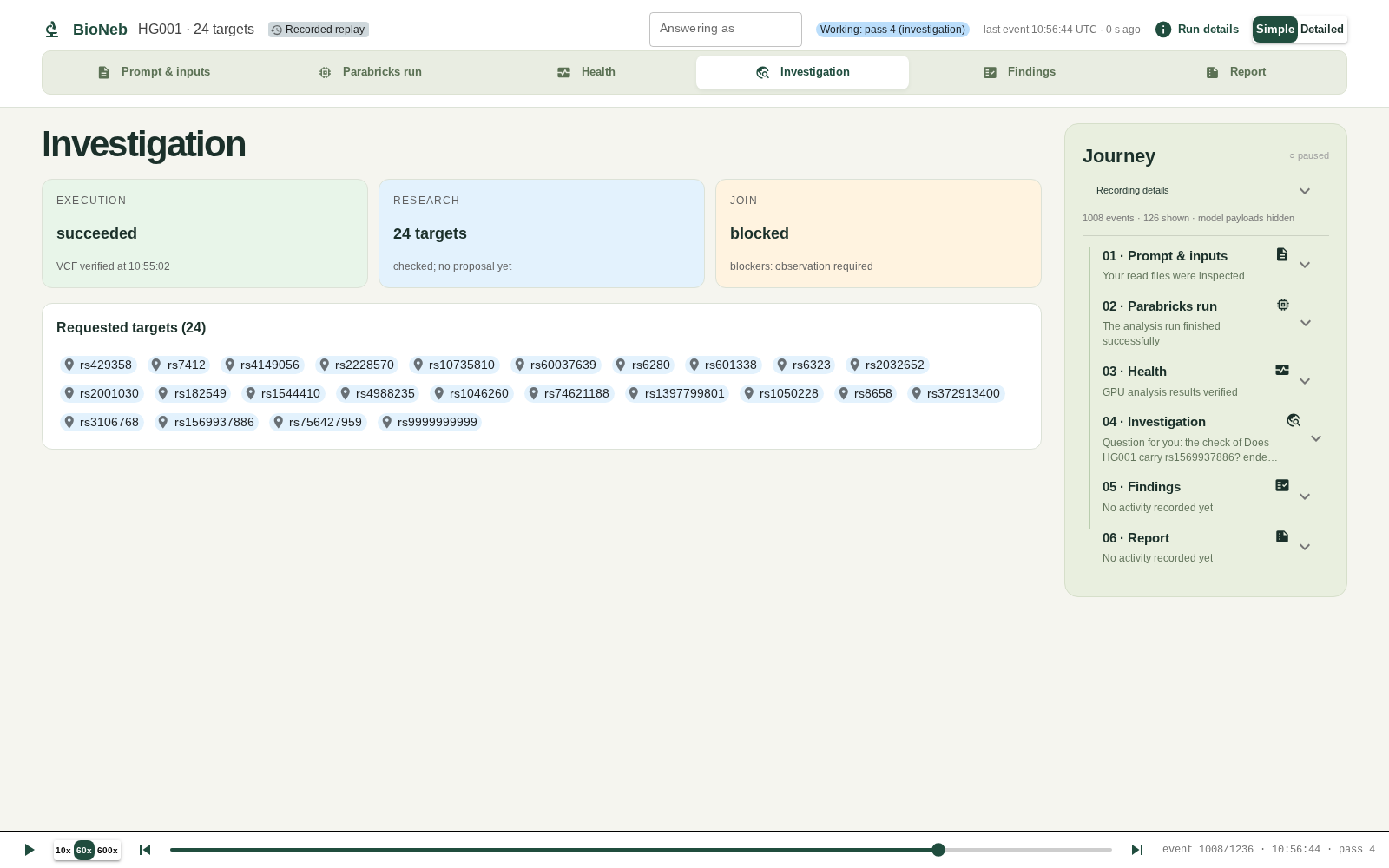
An agent looks up each variant with tools such as NCBI and EVA, and turns loose names into exact Work items for the researcher to approve. One name can hide two different letter changes, or have been merged into another.
Technical detail
The investigation_planner calls fetch_refsnp,
fetch_assembly_report and compile_proposal. rs4149056 sits at NC_000012.12:21178615 with two
alternate alleles, so it becomes two Work items, T>A and T>C. An older ID the researcher also listed,
rs60037639, had been merged into it by dbSNP; the same two items serve it. 24 rsIDs became 29 Work items; the 2 planted bad
IDs stayed unresolved R3 R4.
Findings
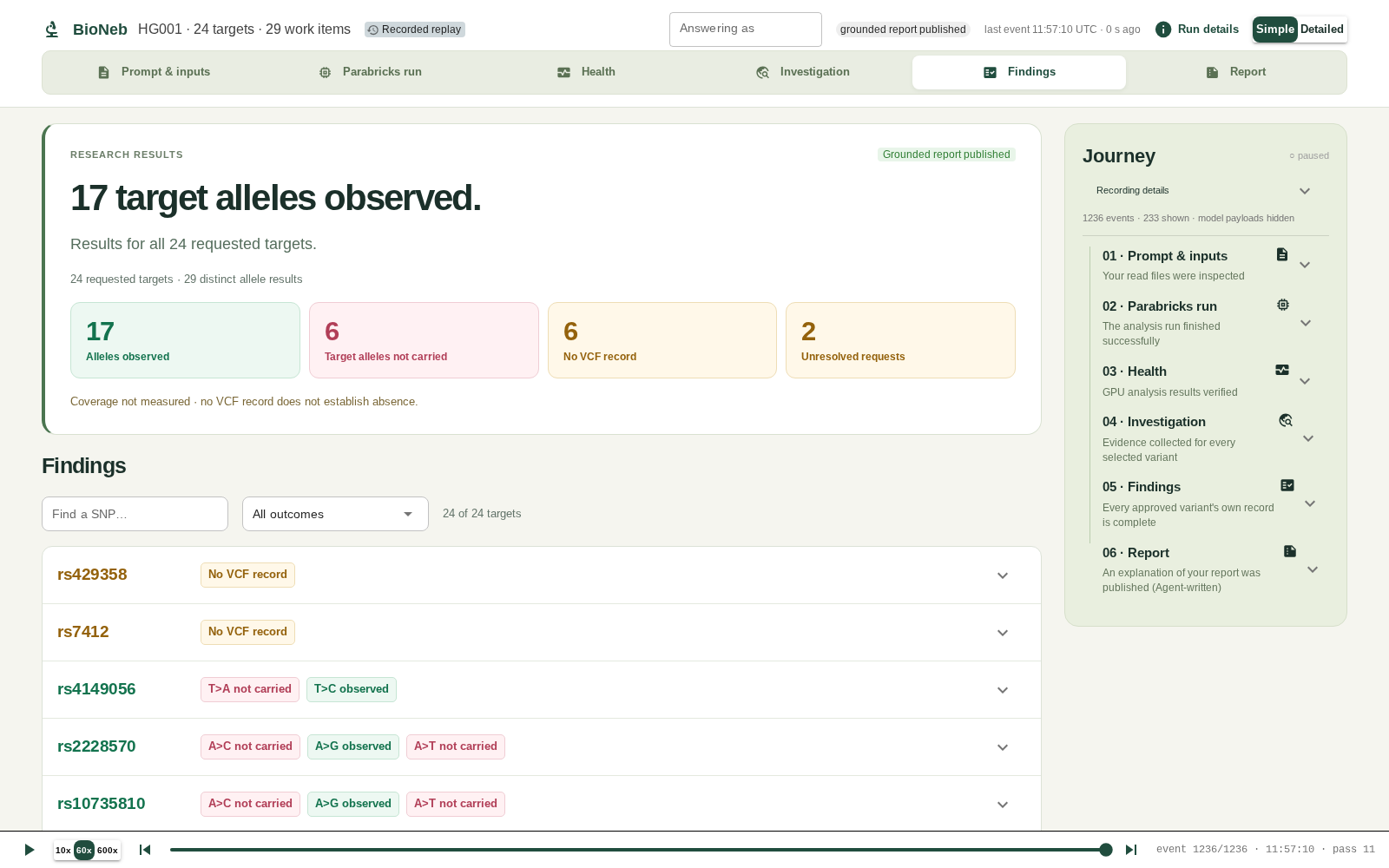
Each Work item gets exactly one answer from the sample's own data: observed, not carried, no VCF record, or unresolved. "No record" is never turned into "not carried". When the agent runs into a conflict, it brings it to the researcher, and only that item waits. It's a collaboration.
Report
An agent presents the results and writes a report of the findings in plain words. It may cite only approved facts, and every citation opens that fact in the Journey.
"…the exact T>C allele at 21178615 is carried (heterozygous 0/1), while the T>A target at that same position is not carried. [3b84b6f1…, 331defe6…, …]"Run H's explanation for rs4149056.
Technical detail
The report_explainer may cite only facts in the approved basis.
A malformed output gets a short repair note, a bounded number of times, and is then refused R9.
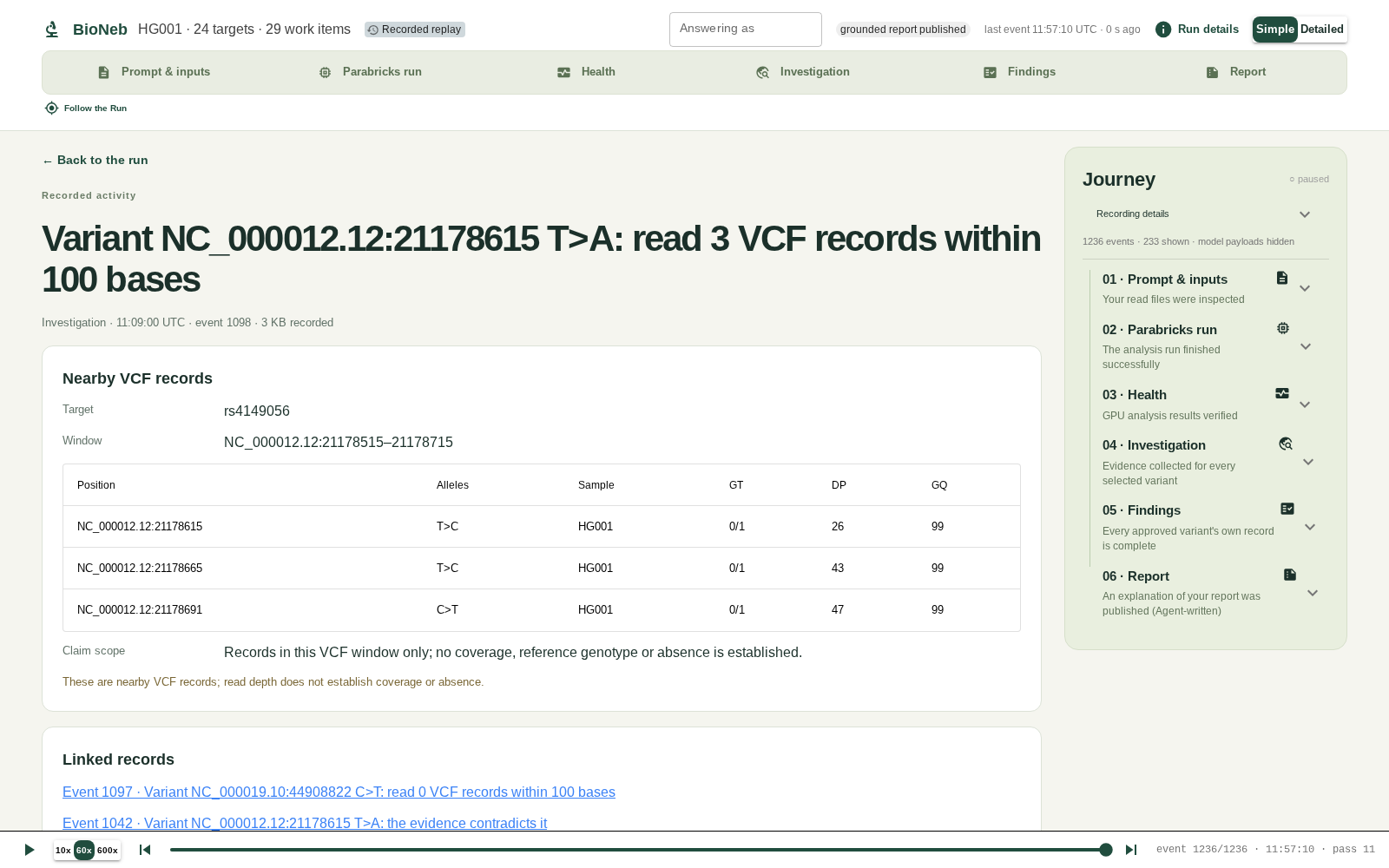
The Journey
The Journey sits under all five stages. Every model call, tool call, approval and file is a fact, stored
once and never changed. The researcher reads it while the Run happens and afterwards; the agents read it too.
A finished Run is not a dead end: fork starts a new branch from it with zero new external calls,
leaving the original untouched.
Technical detail
The Journey file: append-only, immutable typed facts, plus write-once files stored under the SHA-256 of
their bytes. Run H: 1,834 facts of 65 kinds and 337 files, all re-verified R14.
Reading it makes no contact and changes no byte R15; agents query it
through search_journey R16. A finished Run can be forked
from a closed point with 0 contacts R10.